- HOME
- 5 Best Amazon S3 Alternatives for Modern Cloud Storage
5 Best Amazon S3 Alternatives for Modern Cloud Storage
- Last Updated : September 15, 2026
- 2.6K Views
- 3 Min Read

Table of Contents
- What to consider when choosing an object storage platform
- Top Amazon S3 alternatives to evaluate
- Amazon S3 Alternatives FAQs
What to Consider When Choosing an Object Storage Platform
- Storage Scalability & Durability: Can it handle billions of objects and terabyte-plus files without breaking a sweat?
- High durability guarantees matter when downtime equals lost revenue.
- Pricing Transparency: Predictable pricing beats “free tier” illusions. Hidden fees for API requests, lifecycle operations, or egress can balloon costs fast.
- Integration with Compute Services: Storage without seamless integration is like a hammer without a nail.
- Look for native hooks into serverless functions, containerized apps, or workflows.
- Security & Access Control: Encryption at rest, fine-grained IAM, bucket policies, audit logs—non-negotiable for compliance and peace of mind.
- Performance & Latency: Low-latency access under concurrent loads is critical.
Top Amazon S3 Alternatives to Evaluate
Here’s the real talk: S3 isn’t going anywhere but alternatives are gaining traction by solving the pain points developers care about. Let’s break down the top contenders:
1. Catalyst Stratus
Stratus is ideal for cost-conscious teams building integrated cloud applications.

Key features:
- S3-compatible object storage for easy migration and integration.
- Zero data egress/bandwidth fees
- Predictable pricing model with no charges for API requests.
- Native integration with Catalyst Functions, AppSail, and Signals for event-driven automation.
- SDK support for Java, Node.js, Python, Web, Android, iOS, and Flutter.
- Multipart uploads and downloads for handling large files efficiently.
- Object versioning and rollback capabilities for data protection.
- Fine-grained access controls at both bucket and object levels.
- AES-256 encryption at rest with built-in malware scanning.
- Activity logs and auditing features for monitoring and compliance.
- Predictable pay-per-use pricing with generous free monthly usage limits.
- Built-in scalability for handling growing application workloads.
Catalyst Stratus helps developers connect storage, compute, and automation services without relying on additional infrastructure or integrations.
Stratus keeps your data secure, compliant, and fully under your control letting developers focus on building features instead of managing storage.
2. Google Cloud Storage
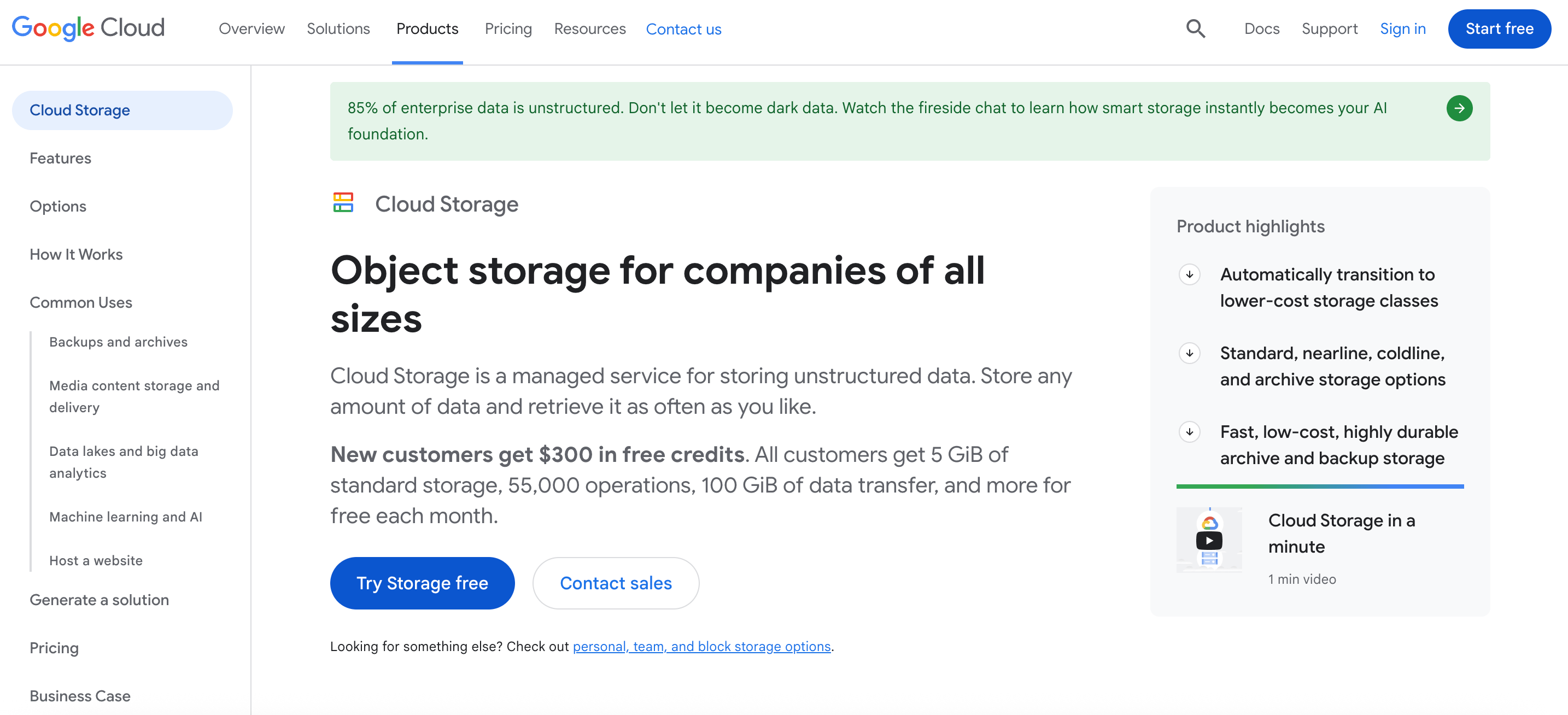
- Multiple storage classes: Standard, Nearline, Coldline, Archive for cost optimization.
- Tight integration with Google’s analytics (BigQuery) and AI/ML (Vertex AI) services.
- Automated lifecycle management to move objects between classes.
- Strong consistency across regions and built-in versioning/retention policies.
- Global edge network for faster access and optimized performance worldwide.
- Compliance-ready with built-in support for standards like GDPR, ISO, and SOC.
- Fine-grained access control using signed URLs and time-bound access.
- Seamless integration with Kubernetes (GKE) and serverless services like Cloud Run and Cloud Functions.
Check Pricing information here
3. Azure Blob Storage
- Hot, Cool, Archive tiers for flexible access.
- Native integration with Microsoft services.
- Strong compliance and durability, especially for regulated industries.
- Multiple redundancy options (LRS, ZRS, GRS, RA-GRS) to support availability and disaster recovery strategies.
- Lifecycle management policies to automate tiering and data retention.
- Commonly used in regulated industries when deployed with appropriate governance controls.
Check pricing here.
4. Wasabi
- Single hot storage tier, eliminating tier-based complexity.
- Designed for backup, archive, and secondary storage use cases.
- Subject to minimum storage duration and capacity requirements, depending on the plan.
Check pricing here
5. Cloudflare R2
- Globally accessible via Cloudflare’s distributed network, reducing latency for end users.
- Suitable for static assets, media delivery, and edge-based application architectures.
- Data placement and access behavior depend on Cloudflare’s platform design, rather than traditional multi-region replication.
Check pricing here
Each platform targets a slightly different developer pain point: cost, simplicity, speed, or ecosystem integration. But storage that plugs directly into your application stack often saves far more time than any pricing differential.
When to Pick Catalyst Stratus
Stratus is the right fit if you:
- Build cloud-native or serverless apps.
- Want storage tightly coupled with compute and workflows.
- Prefer predictable, developer-friendly pricing.
- Need secure, scalable, automated object storage.
- In short: Stratus transforms storage from a separate headache into a core productivity tool for modern application developers.
Amazon S3 Alternatives FAQs
Q: Can Stratus handle large-scale storage?
A: Yes. It scales with your app’s growth and supports petabyte-level unstructured datasets.
Q: Is Stratus secure?
A: Absolutely. Encryption at rest, access control, and project-level isolation are standard.
Q: Who should choose Stratus?
A: Developers, startups, and teams building serverless, event-driven apps that need integrated, predictable, and secure storage