- HOME
- Event-Driven Architecture: The Key to Faster and More Responsive Systems
Event-Driven Architecture: The Key to Faster and More Responsive Systems
- Last Updated : March 2, 2026
- 31 Views
- 2 Min Read

Ever wondered how Uber manages to handle millions of rides happening across the world at the same time, matching drivers to riders, calculating fares, updating maps, and processing payments almost instantly?
Behind that seamless experience lies event-driven architecture (EDA), a design approach that lets Uber’s systems react to what’s happening in real time instead of waiting for a chain of requests to complete.
What is EDA?
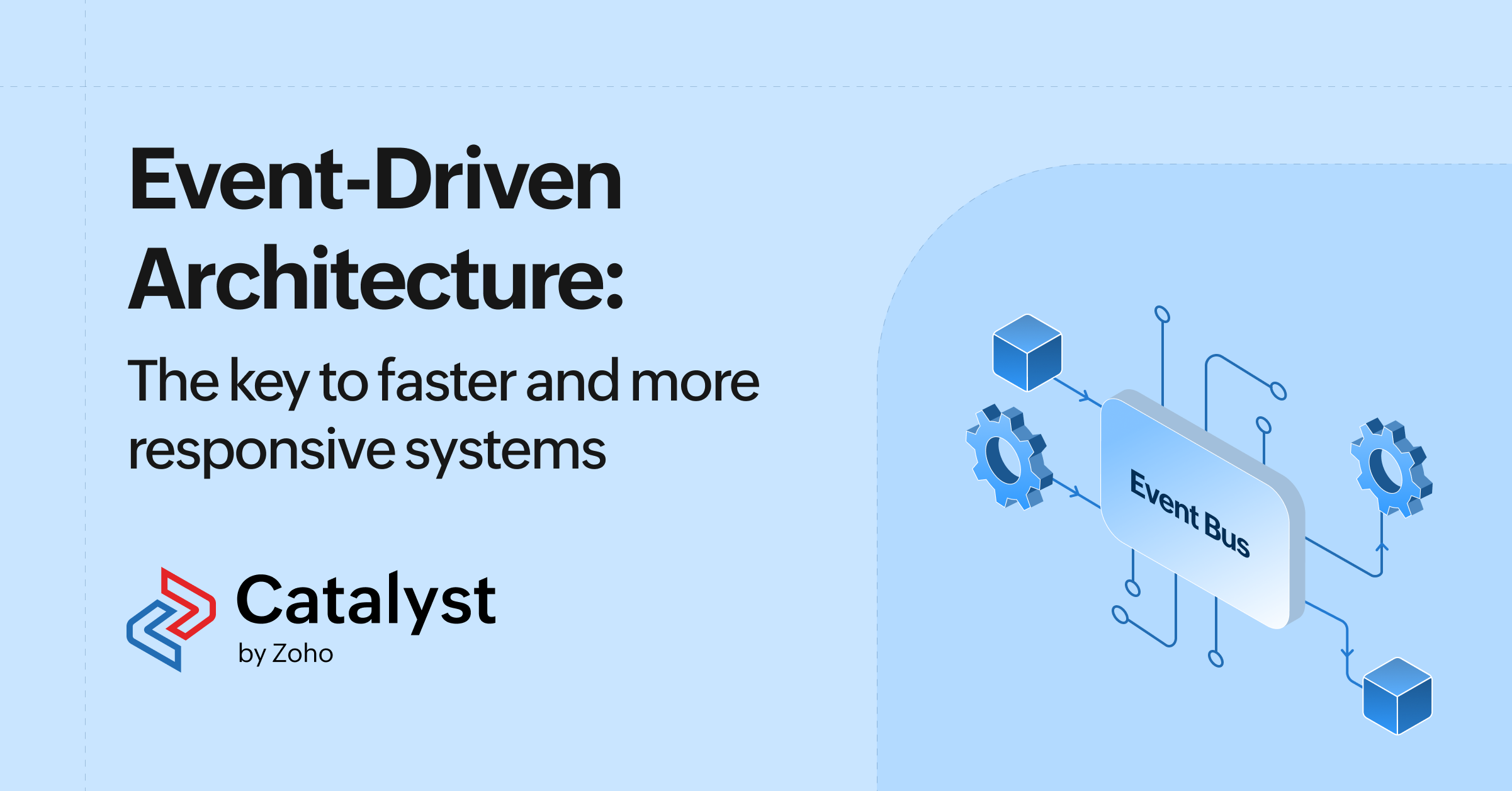
Event-driven architecture is a design pattern in which application logic is driven by events. It’s fundamentally different from traditional request-response architectures where components talk to each other via direct method calls or request APIs.
In EDA, applications publish events on the occurrence of a significant event in the system, such as when a new user signs up, a transfer is initiated, or an account is deleted. These events notify relevant parties (other apps and services) that have subscribed to receive them.
Benefits of EDA
The decoupled approach of EDA provides several benefits over traditional architectures:
- Loose coupling:
Services are loosely coupled in EDA. This means that they don't need to be aware of each other's implementation details or internal state. This simplifies development, maintenance, testing, and deployment.
- Scalability:
Applications can be scaled independently without impacting others, and event processing can be distributed for optimal performance.
- Responsiveness:
Event-driven apps react to events in near real time, which leads to faster response times and improved user experiences. This becomes especially important for applications that need low-latency interactions, such as web apps.
- Extensibility:
Since events serve as a common communication mechanism, organizations can easily integrate third-party systems and services into their ecosystems.
- Improved developer productivity:
EDA promotes a focus on business events rather than complex communication protocols. This helps simplify development and allows developers to focus on core business logic.
Your next step
There are lots of solutions in the market that could help you configure EDA for your business.
If you want to eliminate data silos, ensure all of your systems are synced in real time, and at scale, check out Catalyst Signals, a scale-driven service for EDA.
Learn more about EDA in our ebook on Navigating emerging technologies for business reinvention.
Check out other relevant blogs on how Catalyst Signals can help you:
- Every Moment Counts: Build Apps That Respond With Precision
- Build with Catalyst: Automate your sales incentive flow from Zoho CRM
- Build with Catalyst: Lead enrichment with CRM Event Listeners