- HOME
- Meet Catalyst 3.0
Meet Catalyst 3.0
- Last Updated : September 9, 2026
- 300 Views
- 5 Min Read

AI coding agents have changed how quickly software can be written. But writing code is only part of building an application. The harder work still involves provisioning infrastructure, connecting services, configuring identity and permissions, deploying reliably, and keeping humans in control of production. Catalyst 3.0 brings those capabilities into the agent workflow.
Catalyst 3.0 is an agent-ready, full-stack cloud platform. Developers describe the application they want to build, AI helps create it, and Catalyst provides the infrastructure required to run it in production, like relational databases, object storage, front ends, compute, schedulers, event busses, and AI services.
Every platform operation that used to need a human at a dashboard is now a structured, callable operation: creating a table, configuring auth, deploying a function, provisioning storage, and wiring event triggers. You and your agent reach through two different doors into the same room: one Data Store, one set of security rules, and one set of permissions. The SDK is your door. Catalyst MCP is your agent's. Write a permission once, and it governs both.
What’s new in 3.0?
Catalyst 3.0 introduces three major changes to the developer experience: AI agents that understand Catalyst, MCP-powered access to platform capabilities, and a full-stack platform designed to take applications from code to deployment.
Together, they let developers move from prompting for code to building and deploying complete applications with their agents.
Here's the three new capabilities make that possible.
1. Catalyst Agent Skills teach the agent the platform.
Every cloud ships documentation the models were never trained on, so a service launched today is invisible to every model in use today. The skill closes that gap with trigger rules that route to one reference file, decides between a serverless function and an AppSail container, and checks for deprecated services and region availability before anything gets recommended.
2. Catalyst MCP lets the agent act.
Table creation, auth configuration, function deploys, and bucket management are exposed as structured, schema-defined operations. Every call fetches its schema first, which eliminates the most common agent failure mode: guessed arguments. Provisioning a table by hand takes five-plus minutes while, through MCP, it takes about thirty seconds.
3.A non-interactive CLI lets the agent finish the job.
Agents can't drive arrow-key menus, so every interactive prompt used to be a dead end for automation. Every prompt is now a flag instead, across the whole lifecycle: login, init, functions, client, deploy, and pull. Destructive options are blocked in that mode, so automation can't silently destroy deployed resources. MCP sources the IDs. The CLI acts on them.
You stay in control
Development and production are decoupled, and code reaches production by manual promotion only. The agent provisions and deploys into development. A human promotes. It runs under its own scoped collaborator profile, destructive commands are disabled in non-interactive mode, and application, platform, and MCP tool-call logs let you reconstruct exactly what it did and when. Every change after launch is versioned and reversible.
While the agent writes code probabilistically, the path from that code to a deployed, governed application stays deterministic.
What it changes
The agent needs to understand the platform, know which services to use, access the right APIs and project context, and execute deployment tasks correctly.
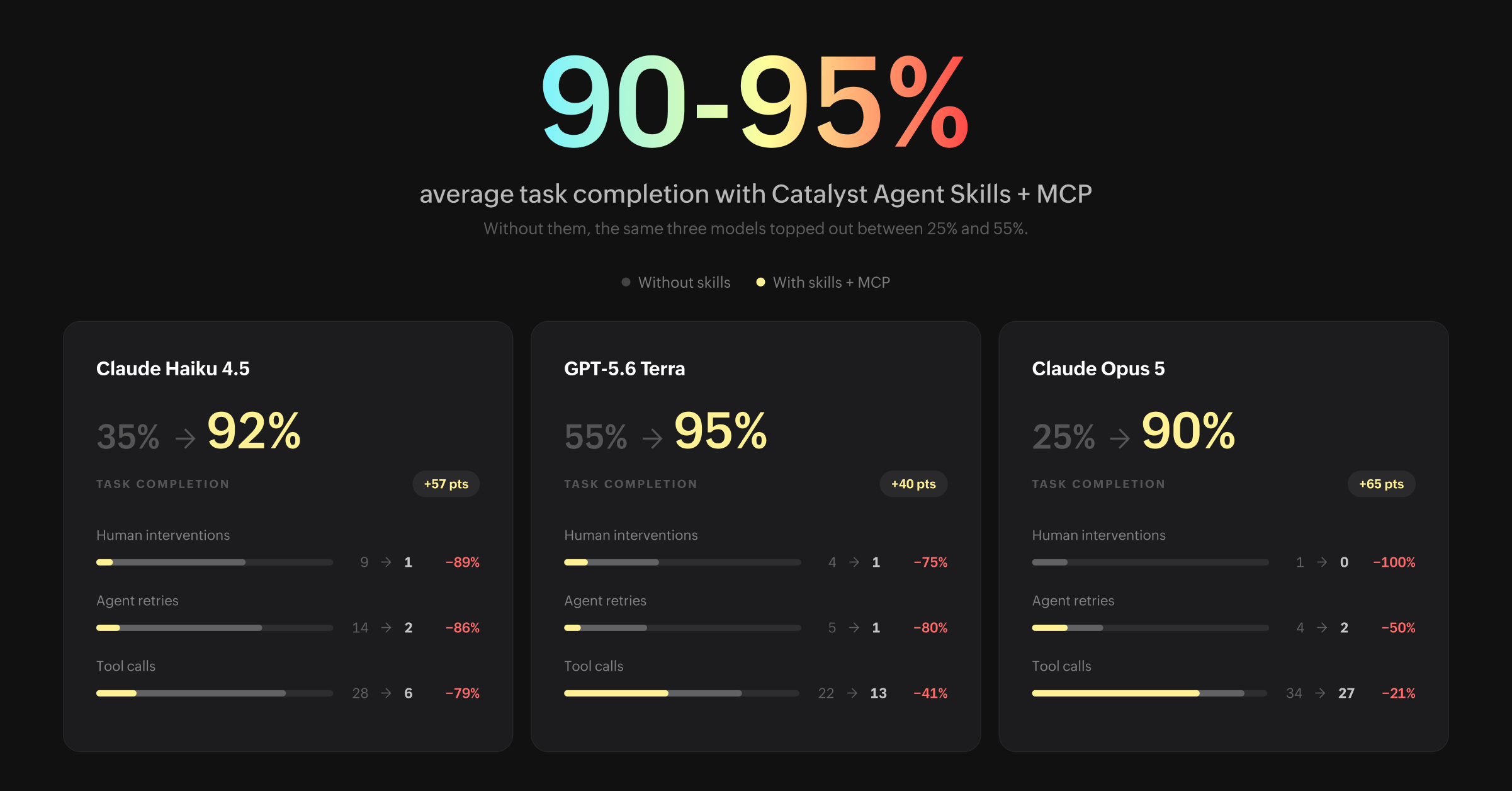
We tested the same end-to-end build task across three leading AI models, first without Catalyst Agent Skills and MCP, and then with both enabled. Without this platform-specific context and tooling, task completion ranged from 25–55%, often requiring human intervention to resolve configuration, provisioning, or deployment issues.
With Catalyst Agent Skills and MCP, task completion increased to 90–95%, while human interventions dropped to 0–1%. Here’s the same build task across all three models, with and without Catalyst Agent Skills and MCP.
Every agent lands at 90–95% task completion with skills, and human interventions drop to nearly zero.
Catalyst 3.0, in production
One of the early adopters of Catalyst 3.0 was a non-profit movement with two million members. Their experience offers a practical look at what changes when AI-assisted development meets a unified full-stack platform.
The organization relied on fragmented tools and manual workflows and had outgrown its existing messaging tools. This made managing identity, moderation, and engagement increasingly difficult at scale. They wanted a digital engagement app, but building it properly would have meant separate vendors, separate contracts, and no single governance model over two million members’ personal data.
One platform changed the equation
With Catalyst 3.0, the developer could work with a single platform for the application’s backend services, infrastructure, and workflows instead of stitching together multiple vendors. AI-assisted development further accelerated the process, allowing the developer to move from requirements to a working application without spending weeks on platform setup and integration.
One developer, in three weeks, built a solution for iOS, Android, and web with managed authentication for two million verified identities, a relational backbone for membership and constituency records, approval and moderation workflows on AppSail, and scheduled jobs running automated moderation sweeps.
The result was a production-ready application built around a unified platform, with the infrastructure and governance needed to support a two-million-member community.
What the market says
"Agentic AI coding agents are good at generating large volumes of code, but assembling the various components of a working application and deploying it into production are still too difficult. With Catalyst, developers can leverage the platform's agent skills, MCP server, and built-in orchestration capabilities to deploy fully functional deterministic applications on the world-class Catalyst PaaS."
— Jason Bloomberg, Managing Director, Intellyx
”Catalyst gave us a full-stack platform to deliver a single source of context across the Zoho applications that power our business, without the overhead of stitching infrastructure together ourselves. What stood out most was speed: a single developer took the solution from concept to a fully deployed, production-ready application in a short span of time. At our scale, that agility fundamentally reshapes how we build and scale internal digital solutions."
Aasheesh Agrawal — Lead, Digital & IT, Eternia by Hindalco (Aditya Birla Group)
The opportunity for SIs
“AI is changing the economics of bespoke software. As AI coding agents dramatically reduce the effort and time involved in software development, SIs can build more, experiment faster, and take on specialized solutions that were previously too costly or time-consuming to justify. There's a bigger opportunity for SIs and custom development firms: more specialized applications, more tailored experiences, and greater value delivered to every customer. But as development accelerates, the friction shifts to deployment, where developers often stitch together multiple vendors for the front end, back end, databases, security, and cloud infrastructure. Catalyst unifies these capabilities in a single full-stack platform, making the entire development-to-deployment lifecycle more efficient, reliable, and predictable.”
-- Anand Nergunam, Vice President, Revenue Growth at Zoho
Try Catalyst with your AI agent
Catalyst Agent Skills is public and Apache-2.0 licensed, with native installation for Claude Code, Gemini CLI, Cursor, GitHub Copilot, Windsurf, OpenAI Codex, and Kiro. The Catalyst SDKs, CLI, and Slate front-end framework are open source too, so you can see how it works before you build with it.
Install the skill.Connect MCP. Authenticate once. Start building.
Describe what you want, and your agent can read the Catalyst skill, resolve your project IDs through MCP, provision a table, configure authentication, deploy a function, and hand you a working endpoint. Promote it to production when you’re ready.
Setup instructions for every supported tool, including Catalyst MCP configuration, are available in the repo README.
Go build something your agent couldn’t touch yesterday. Start with Catalyst.
Explore More
- Catalyst 3.0 — Everything you need to know
- Agentic Coding Video Tutorials — Learn how to build with AI agents
- Catalyst Agent Stack — Explore the tools behind agentic development
Happy building with Catalyst!