- HOME
- Meet the Makers: Fristine Infotech Pvt Ltd
Meet the Makers: Fristine Infotech Pvt Ltd
- Last Updated : May 11, 2026
- 93 Views
- 18 Min Read

Celebrating Catalyst-powered innovations and the developers behind them.
Meet the Makers is a Q&A series that shines a spotlight on the brilliant developers within our community. We aim to showcase the diverse range of innovative solutions our community members have built using Catalyst. Join us in celebrating their achievements, learning from their journeys, and exploring how they leveraged Catalyst's capabilities to bring their visions to life.
So, grab your favorite coding beverage, put on your coolest developer cap, and join us as we meet the makers who are reshaping the digital landscape with Catalyst!
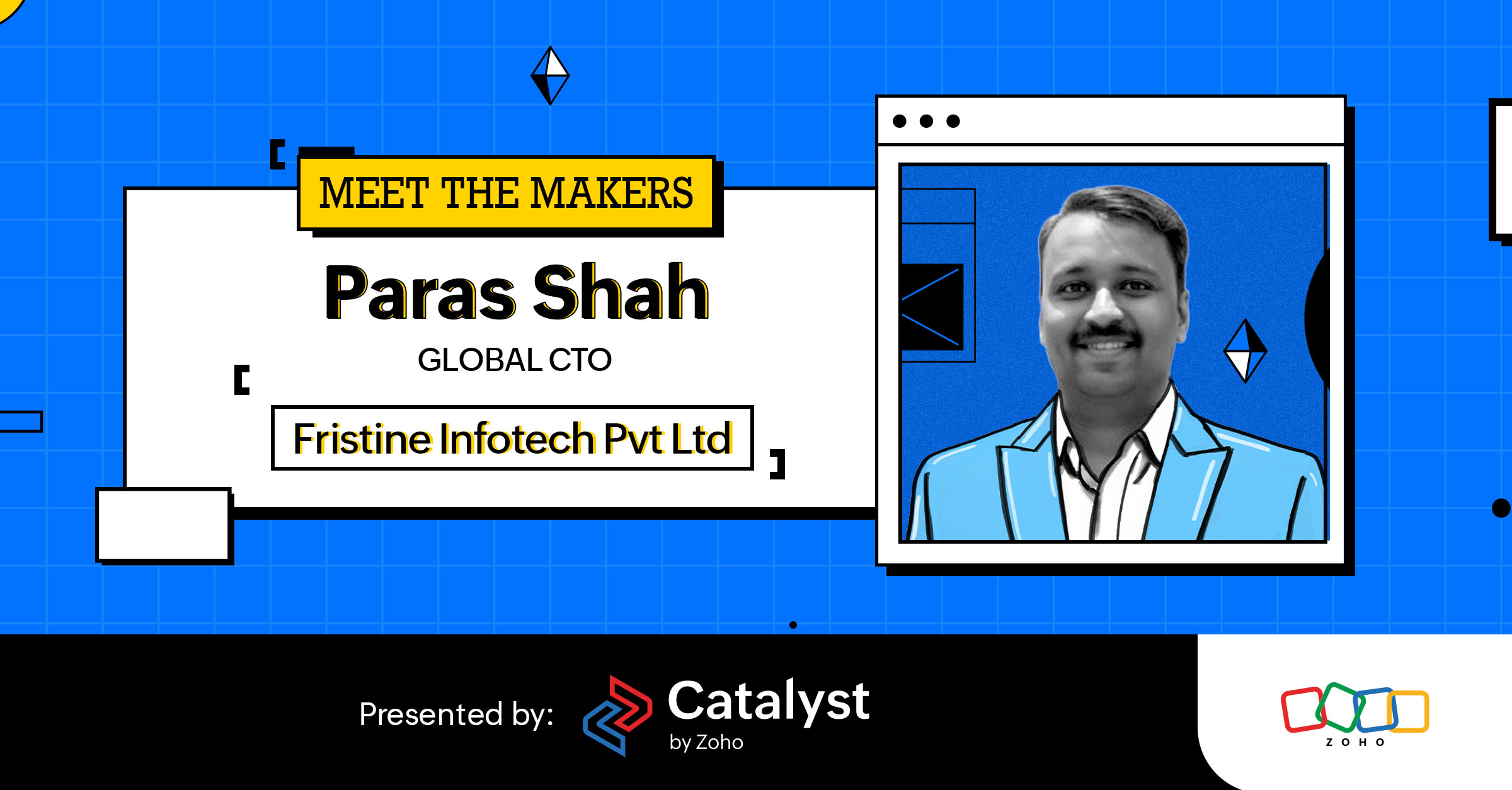
Now, let's kick off our Meet the Makers interview! Today, we have the pleasure of talking to Mr. Paras Shah, Global CTO of Fristine Infotech Pvt Ltd, a coding maverick who has built an exceptional application using Catalyst. Let's jump right into the conversation and learn from his incredible journey.
Q1. Could you tell us a bit about yourself? How did you discover Catalyst, and what made you choose it for your project?
I'm Paras Shah, Global CTO of Fristine Infotech, a Zoho Premium Partner specializing in delivering end-to-end Zoho solutions tailored to specific industry needs and customer requirements. Our expertise spans the entire Zoho ecosystem from CRM and finance to HR and operations.
As we worked closely with clients across various sectors, we encountered scenarios where standard Zoho applications needed to be extended with custom portals and applications. That's when we discovered Zoho Catalyst.
What made Catalyst the natural choice for us was the philosophy of keeping everything under one roof. Rather than directing our clients to an external cloud platform with separate billing and vendor relationships, Catalyst allowed us to build custom applications that natively integrate with Zoho products within the same environment our clients already use.
Q2. Could you provide an overview of the project you built on Catalyst? What problem were you aiming to solve, or what need were you trying to fulfill?
So, we built a dynamic Page Builder application for one of our BFSI clients. The application enables non-technical users to create fully functional landing pages through a simple drag-and-drop interface with no developer involvement.
The problem we were trying to solve was that our BFSI client frequently launches time-sensitive loan campaigns and product offers. Every new campaign required a dedicated landing page, and that meant looping in developers each time. This process was really costly and slow, and it created bottlenecks that delayed campaigns and reduced the team's agility.
So, in our Page Builder application, we added prebuilt templates to match the client's brand, a drag-and-drop interface to compose and arrange page elements easily, configurable forms with field-level customization, auto-generated shareable page URLs for instant publishing and distribution, UTM parameter capture to track campaign performance and traffic sources, OTP-based form validation to ensure lead authenticity, and CAPTCHA integration to prevent spam and bot submissions.
Now, the client's marketing team can independently build and publish campaign landing pages in minutes, eliminating developer dependency and dramatically reducing both cost and time to launch.
Q3. What were the specific Catalyst features or tools that played a crucial role in your development process?
The core of our application logic runs on Catalyst's Cloud Functions. All back-end operations were built as serverless functions. This allowed us to focus purely on business logic without worrying about server provisioning, scaling, or maintenance.
We used Catalyst Data Store to make sure all dynamic application data persisted. Its table-based model made querying and managing relational data straightforward, and the tight integration with Cloud Functions kept our data operations clean and efficient.
For media management, we used Catalyst Stratus. All the media files we used within Page Builder are stored and served there. Its reliability and seamless integration within the Catalyst ecosystem eliminated the need for external storage solutions.
Both the Page Builder admin interface and the campaign landing pages are hosted on Catalyst's Web Hosting. The ability to deploy front-end builds directly through Catalyst kept our entire stack within a single platform and simplified our CI/CD workflow significantly.
Catalyst's built-in authentication handled access control for the admin panel, ensuring only authorized marketing team members could log in and manage pages. This saved us considerable development time that would otherwise have gone into building a custom auth system from scratch.
All communication between the front-end and back-end functions is routed through Catalyst's API Gateway. It allowed us to expose our serverless functions as clean REST endpoints, manage request routing, and maintain a secure and structured communication layer between the client and server.
And from a developer workflow perspective, Catalyst CLI was a standout tool. It streamlined local development, testing, and deployment across all services from a single command line interface, which significantly improved our development speed and deployment consistency.
Q4. What were some of the challenges you encountered along the way, and how did you overcome them using Catalyst?
One of the most complex challenges was designing a system where a user's drag-and-drop actions on the builder interface could be saved as a structured configuration and then accurately rendered as a live, publicly accessible landing page.
We solved this by storing the entire page layout as a JSON configuration in Catalyst Data Store. When a page URL is accessed, a Cloud Function retrieves the corresponding JSON file and dynamically renders the page on the fly, ensuring what the user builds is exactly what the visitor sees.
The next challenge was in allowing marketing users to upload brand assets, banners, and images directly within the builder. It introduced challenges around storage reliability and delivery speed. By integrating Catalyst Stratus as our object storage layer, we were able to handle media uploads securely and serve them efficiently. Stratus gave us a scalable and dependable storage backbone without needing to configure or manage any external storage infrastructure.
Then, since forms on the landing pages are configured dynamically by the user, integrating OTP-based validation in a way that worked consistently was a challenge. We addressed this by building a dedicated OTP generation and verification flow using Catalyst Cloud Functions. It operates independently of the form structure and can be triggered reliably, regardless of how the form is configured by the end user.
Another challenge was integrating CAPTCHA within a dynamically built form environment. We resolved this by implementing CAPTCHA validation as a server-side check within our Cloud Functions, so every form submission passes through a CAPTCHA verification step before the data is processed or stored.
We also ran into issues with accurately capturing UTM parameters from the landing page URL and associating them with the correct form submission in real time, particularly when multiple campaigns were running simultaneously on different pages. We handled this by passing UTM values as part of the form submission payload through the API Gateway to the Cloud Function, which then stores them alongside the lead data in Data Store.
Lastly, each published page needed a unique, shareable, stable, and accessible URL. We implemented URL generation logic within Cloud Functions that creates a unique page identifier upon saving, stores it in Data Store, and maps it to the corresponding page configuration.
Q5. How would you describe the overall developer experience with Catalyst? Were there any standout features or aspects that impressed you?
The overall developer experience with Catalyst has been outstanding. As a team that works primarily within the Zoho ecosystem, what impressed us most was how thoughtfully Catalyst is designed.
It's not just a hosting or functions platform; it's a complete, production-ready development ecosystem. Catalyst's Cloud Scale suite essentially gave us a fully managed backend out of the box, and one of the aspects that genuinely impressed us was how seriously Catalyst treats DevOps as a first-class concern rather than an afterthought.
The serverless offering was the foundation of our development experience. What impressed us there was the range it covers under a single umbrella. Cloud Functions gave us the flexibility to write event-driven back-end logic cleanly and efficiently. Whether it was handling form submissions, OTP verification, or UTM capture, every operation ran as an independent, scalable function without us ever touching a server configuration.
Another great feature is API Gateway, which gave us clean, structured control over how our serverless functions are exposed as REST endpoints. Features like authentication enforcement and request throttling at the gateway level added an important layer of security and reliability to our application.
Catalyst's Signals service also stood out as a forward-thinking feature. For our current project, real-time event communication between decoupled components was a requirement. It’s the kind of feature that becomes increasingly valuable as applications grow in complexity, and having it natively available within the platform is a significant advantage.
Slate also impressed us with how effortlessly it handles front-end deployment and scaling for JavaScript framework-based applications. For teams that want to move fast on the frontend without dealing with complex hosting configurations, Slate removes that friction entirely and gets applications live quickly.
From a day-to-day development workflow perspective, the Catalyst CLI was a standout experience. A single CLI gave us unified control over functions, hosting, data, and deployments from the terminal. It streamlined our local development and testing cycle significantly and made the transition from development to production smooth and predictable.
What truly sets Catalyst as a whole apart in developer experience is the cohesion of the platform. Every service is designed to work together seamlessly. As developers, this means less time spent on integration plumbing and more time focused on building features that deliver real value to clients.
For a Zoho Partner like us, Catalyst is a strategic advantage that allows us to deliver complete, custom solutions entirely within the Zoho ecosystem.
Q6. Now, let's talk about the impact your project had on your target audience or users. Have there been any notable successes or feedback you've received?
Before Page Builder, every new loan campaign or product offer required our client's marketing team to raise a request to the development team, wait for a developer to build the landing page, go through review cycles, and then go live. This entire process was time consuming and directly impacted the client's ability to respond to market opportunities quickly.
After Page Builder went live, the marketing team became completely self-sufficient. They can now select a prebuilt, brand-aligned template, configure the form fields, drag and drop elements to compose the page, and publish it with a shareable link without writing a single line of code or involving a developer.
One of the most celebrated outcomes by the client was the dramatic reduction in the time it takes to launch a new campaign landing page. What previously took days now takes less than 30 minutes. This agility has given the client a meaningful competitive edge in launching time-sensitive loan offers and promotional campaigns.
Every landing page previously built by a developer also came with an associated cost in terms of developer time, project management overhead, and delayed campaign revenue. With Page Builder in place, the client has significantly reduced the recurring cost of campaign page creation. The marketing team operates independently, and development resources are freed up for higher-value technical work.
The return on investment for the Page Builder solution was realized within a short period post-launch.
Before Page Builder, campaign forms were susceptible to spam submissions and unverified leads. With OTP-based validation and CAPTCHA integration now built into every form, the quality of leads captured improved noticeably.
The sales team reported a higher rate of genuine, contactable leads coming through the campaign pages, directly improving their conversion pipeline.
The built-in UTM parameter capture also gave the client's marketing team clear, reliable data on which channels and campaigns were driving the most traffic and leads. Whether the page was shared via WhatsApp, email, social media, or SMS, the UTM values were captured and stored alongside each form submission.
This enabled the marketing team to make data-driven decisions about where to invest their campaign budgets.
Perhaps the most meaningful feedback we received wasn’t about a specific metric but about how the solution changed the way the marketing team works. The team members took to the application quickly and confidently.
The simplicity of the drag-and-drop interface, combined with the prebuilt brand templates, meant they could build pages that were always on brand and professional without needing design or development support.
The client's marketing head specifically appreciated that the tool was built around their workflow and their brand. That level of tailored fit, delivered within the Zoho ecosystem through Catalyst, was something the client highlighted as a key differentiator compared to the off-the-shelf alternatives they had evaluated earlier.
It delivered not just technical value but real, measurable business impact. That is ultimately what we strive for as a Zoho Partner.
Q7. Looking back, is there anything you would have done differently during the development process or any lessons learned that you'd like to share with other developers?
Reflecting on the development journey of the Page Builder application, there are definitely a few things we would approach differently if we were starting over.
One of our honest reflections is that we didn’t fully explore everything Catalyst had to offer before we began development. We started with the services we were already familiar with and discovered additional capabilities mid-development.
Had we done a thorough discovery of all available Catalyst services up front, some of our early architectural decisions would have been different and more efficient. For example, Circuits could have been leveraged earlier to orchestrate our multi-step function workflows rather than managing that logic manually through code.
Our initial build was also tightly scoped around a single client's requirements. The data models, configuration structures, and business logic were designed with one tenant in mind. As we began to see the potential of Page Builder as a product that could be offered to multiple clients, we had to go back and refactor several components to make them configurable and scalable across different tenants. This refactoring took time and effort that could have been avoided with better up-front thinking about the solution's broader potential.
We also underestimated how much iteration would be required to make the drag-and-drop interface genuinely intuitive for marketing team members with no technical background. Our early versions of the builder were functional but required more guidance and training than we anticipated. Multiple rounds of UI refinement were needed before the team felt truly comfortable using it independently.
The back-and-forth could have been reduced with more thorough UX research and low-fidelity prototyping before development began.
Looking back, setting up the CI/CD pipeline on day one is another thing that would have saved us from several instances of inconsistency between environments and would have enforced better development discipline throughout the project.
Oh, another lesson learned is that we started paying close attention to Catalyst's APM and Logging tools only after we encountered some performance concerns post-launch. In hindsight, actively monitoring function execution times, response patterns, and error rates from the early stages of development would have allowed us to catch and address performance issues much earlier.
Then, in the initial phase of development, some of our Cloud Functions were written as larger, multi-purpose functions handling several responsibilities at once. As the application grew, these became harder to maintain, debug, and scale independently. Catalyst's serverless architecture is inherently designed to encourage small, focused, single-responsibility functions, and we should have embraced that principle more strictly from the beginning.
The Page Builder project was a deeply rewarding development experience and a strong validation of what Catalyst can deliver. The lessons we learned are about how we as developers can use the platform more effectively by planning better, exploring more, and embracing the full depth of what Catalyst offers right from day one.
If we were to start this project again today, with everything we now know about Catalyst, I am confident we would build a better, more scalable, and more robust solution in significantly less time.
Q8. As part of the Catalyst community, do you actively engage with other developers or contribute to the platform's ecosystem? If so, how has this involvement benefited you?
Absolutely. As a Zoho Premium Partner, community engagement is not just something we participate in; it's something we genuinely value and consider an important part of how we grow as a team and as a solutions provider.
We regularly participate in Zoho's Partner events, developer summits, and product webinars where Catalyst features, roadmaps, and best practices are discussed. These events have been invaluable for staying ahead of new platform capabilities and understanding how other Partners and developers are approaching similar challenges.
This proactive approach to following the platform's evolution means we are rarely caught off guard by changes and are often among the first in our Partner network to adopt and apply new capabilities.
Being in the room, whether virtually or physically, where Zoho's product teams share the direction that Catalyst is going has allowed us to proactively plan our solution architecture around upcoming features rather than reacting to them after release.
Plus, as a Zoho Premium Partner, we are part of a broader network of Partners across industries.
We actively share our Catalyst use cases, including the Page Builder application, within Partner circles, discussions, and knowledge-sharing sessions. The goal is to inspire other Zoho Partners to look beyond standard Zoho configurations and explore what is possible when Catalyst is brought into the picture. We believe that the more Partners and developers there are who understand Catalyst's potential, the richer the overall ecosystem becomes. And that benefits everyone, including our clients.
On the team side, our development team regularly engages with Zoho's developer forums and community spaces to both seek and offer guidance. When we encounter a technical challenge on Catalyst, the community is often the fastest path to a solution. In the same way, when we've solved a problem that others are struggling with, we make it a point to share our approach.
This two-way engagement has helped us build a deeper understanding of the platform and has, on several occasions, surfaced solutions and workarounds that were not immediately obvious from the documentation alone.
Community engagement doesn't stop at external forums, though. Within Fristine Infotech, we've built a culture of internal knowledge sharing around Catalyst.
Developers who explore new Catalyst features or attend training sessions are encouraged to present their learnings to the broader team. This ensures that our collective knowledge of the platform grows continuously and that every team member is equipped to build confidently on Catalyst.
The benefits of active community engagement have been both direct and compounding. Community discussions and forums have helped us resolve technical challenges faster than working through them in isolation.
Exposure to how other developers use Catalyst has broadened our thinking and influenced smarter design choices in our own projects, and being deeply embedded in the Catalyst ecosystem means we can speak to the platform's capabilities with confidence and credibility when proposing solutions to clients.
Continuous learning through community involvement keeps our developers motivated, sharp, and growing.
For us, being part of the Catalyst community isn't a passive experience; it's an active investment in our own capability and in the health of the ecosystem we build on. The more we contribute and engage, the more we get back in return. We would encourage every developer building on Catalyst to treat community involvement not as optional but as an integral part of their development practice.
Q9. What do you do to take a break from coding?
Taking breaks is something my team and I truly value. We believe a refreshed mind always writes better code!
When we step away from our screens, cricket is usually the first thing that brings the team together.
Whether it’s watching a live match or a quick discussion about last night's game, it's a great way to instantly lift the energy in the room.
Beyond cricket, we enjoy simple things like a good meal with the team, spending quality time with family and friends, and occasionally getting outdoors for a walk or some physical activity.
These moments of genuine connection and rest are what keep us grounded and motivated.
One thing that naturally happens during our breaks and I love this about our team is that conversations often drift toward AI. We find ourselves casually discussing the latest advancements in AI, exploring interesting use cases, and brainstorming how AI-driven solutions could solve complex real-world problems for our clients.
What starts as a casual tea-time conversation frequently turns into a whiteboard session where the team is excitedly mapping out ideas, debating approaches, and connecting AI possibilities to the challenges our clients face. Some of our most innovative solution ideas have actually been born during these informal discussions.
We also enjoy exploring new technology trends, reading about innovations in cloud and AI, or listening to tech podcasts. It doesn't feel like work; it feels like curiosity, and that is a refreshing difference.
At the end of the day, we strongly believe that the best ideas don't always come from sitting at a desk. They come when you step away, breathe, and give your mind the space it needs. Breaks are not a pause from productivity; they're a part of it.
Q10. Finally, what advice or words of encouragement would you offer to fellow developers who are considering or just starting to explore Catalyst for their own projects?
To every developer who is considering Catalyst or just beginning their journey with it: welcome to a platform that will genuinely change how you think about building and delivering applications.
Here is our honest advice from experience:Just start. Don't wait until you know everything. The biggest mistake you can make is waiting until you feel fully ready. Catalyst is designed to be developer friendly, and the best way to learn it is by building something real with it. Start with a small, meaningful problem and build a solution end to end. That first successful deployment will give you more confidence than any amount of reading or watching tutorials ever will.
Next, explore the entire platform before you start building. Before writing your first line of code, take time to walk through every Catalyst service. Understanding what is available up front will directly influence how you design your solution. Many developers—including me—discovered powerful features mid-development that would have shaped better architectural decisions if known earlier.
Third, think in the Zoho ecosystem. Catalyst's greatest strength is its native, seamless integration with the entire Zoho product suite. If you're a Zoho developer or Partner, design your solutions with that integration in mind from day one. The ability to connect your custom application directly with Zoho CRM, Zoho Forms, Zoho Analytics, and other Zoho products without complex API configurations is a competitive advantage that no external cloud platform can match.
Fourth, embrace the serverless mindset. If you're coming from a traditional server-based development background, the shift to serverless thinking is the most important mindset change you need to make. Write small, focused, single-responsibility cloud functions. Let Catalyst handle the infrastructure, scaling, and availability.
Your job is to focus on business logic, and Catalyst takes care of the rest. The more you embrace this mindset, the faster and more efficiently you will build.
Fifth, use Circuits to orchestrate. Don't chain functions manually. One of the most valuable lessons we can share is to leverage Catalyst Circuits for orchestrating multi-step workflows. Circuits handles them elegantly without you having to manage the orchestration logic manually in code. It keeps your architecture clean, maintainable, and easy to visualize.
Sixth, set up your DevOps pipeline on day one. Don't treat CI/CD as something you configure after the application is built. Set up Catalyst Pipelines at the very beginning of your project. Having automated testing and deployment workflows across your development, staging, and production environments from the start will save you from countless headaches later and will enforce a level of development discipline that pays dividends throughout the project lifecycle.
Seventh, monitor early. Don't wait for production issues. Make Catalyst's APM and Logging part of your development process from the very first deployment, not just a post-launch concern. Monitoring function execution times, tracking errors, and understanding response patterns during development will help you catch and fix performance issues before they ever reach your users.
Eighth, explore AI possibilities with QuickML.
If you're building solutions for clients in data-rich industries, don't overlook Catalyst's QuickML. The ability to build and deploy machine learning models as APIs without writing ML code is a powerful capability that can add significant intelligence to your applications. Start exploring it early, even if your current project doesn't require it, because understanding its potential will open new doors for your future solutions.
One of the most important pieces of advice we can offer is this: resist the temptation to bring in external services for needs that Catalyst can already fulfill. Need object storage? Use Stratus. Need notifications? Use Notify.
Need front-end deployment? Use Slate. The more you stay within the Catalyst ecosystem, the more cohesive, maintainable, and cost-efficient your solution will be. External integrations add complexity and cost.
Use them only when Catalyst truly does not cover the need.
And lastly, don't build in isolation. Engage with the Zoho developer community, participate in forums, attend Partner events, and share your own learnings with others.
The Catalyst community is a genuine resource. Problems that take you hours to solve alone can often be resolved in minutes with community input. And as you grow in experience, give back by sharing your knowledge.
A thriving community makes the platform stronger for everyone.
As a final word of encouragement, Catalyst isn't just a development platform; it's a complete ecosystem that empowers you to build, deploy, scale, and maintain full-stack applications with confidence and efficiency.
Whether you're building a simple internal tool or a complex, AI-driven customer-facing application, Catalyst has the services, the infrastructure, and the integrations to support your vision.
As a team that has experienced the journey firsthand, we can say with confidence that choosing Catalyst was one of the best technical decisions we made.
It gave us the ability to deliver a complete, production-ready custom solution entirely within the Zoho ecosystem, and the results spoke for themselves.
So to every developer standing at the starting line: take the step, explore with curiosity, build with confidence, and trust the platform. Your best Catalyst project is waiting to be built.
Stay tuned for our upcoming interviews, where we delve into the journeys of exceptional developers who have made their mark with Catalyst.
Note: If you're a developer and have used Catalyst to create an exceptional app, website, microservice, or solution, we'd love to feature you in our Meet the Makers series. Reach out to us and share your story of innovation and inspiration with the Catalyst community.